Evolution of the Hard Hat: From Steamed Canvas to Modern Helmets
If there is one piece of gear that quietly says “we care about you,” it is the hard hat.
The evolution of the hard hat tells a story about how the construction industry has learned, adapted, and continuously improved the way it protects its people. Long before modern safety standards and OSHA regulations existed, crews were tackling dangerous work with almost no protection. That began to change in the early 1900s when one inventor brought a battlefield lesson home and helped transform jobsite safety forever.
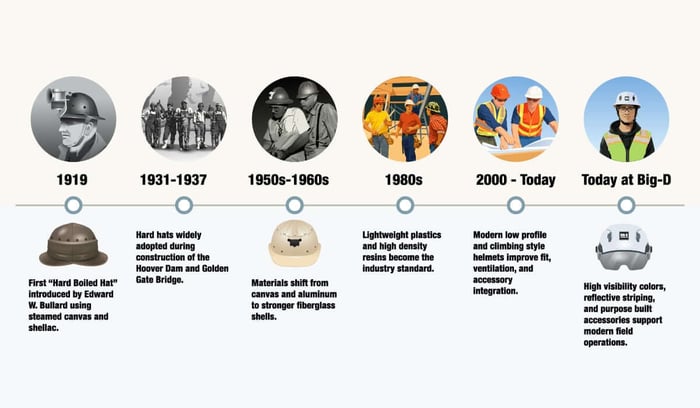
The Origin of Modern Head Protection
In 1919, Edward W. Bullard returned from World War I with a simple but powerful idea. After seeing how military helmets protected soldiers, he designed the first commercial industrial safety helmet for miners. The helmet was made from steamed canvas, glue, and shellac, creating a durable protective shell that became known as the Hard-Boiled Hat. This innovation marked one of the earliest milestones in the history of PPE in construction and laid the foundation for the modern era of industrial head protection.
As large infrastructure projects reshaped the American landscape, protective headgear quickly proved its value. During projects like Hoover Dam construction and the building of the Golden Gate Bridge, jobsite hazards became more visible and better understood. Falling tools, structural materials, and overhead work created constant risks. As a result, hard hats moved from an experimental piece of gear to an expected part of construction safety programs.
How Hard Hats Evolved for the Modern Jobsite
Over the following decades, materials continued to evolve. Early models used aluminum and fiberglass, but manufacturers eventually shifted toward high-density polyethylene and advanced plastic resins. When comparing fiberglass vs plastic hard hats, modern plastics offer improved durability while reducing weight and improving comfort for workers who wear them throughout the day.
Today’s helmets reflect more than a century of innovation in the industrial head protection timeline. The familiar dome shape still exists, but many jobsites are adopting climbing-style safety helmets that sit lower on the head and provide improved stability. These designs are less likely to fall off during overhead work, ladder climbs, or windy conditions, making them increasingly common across industrial and infrastructure projects.
Modern hard hats also incorporate significant improvements inside the helmet itself. Suspension systems distribute impact forces while maintaining space between the shell and the wearer’s head. Many models now include ventilation systems, sweat-wicking liners, and attachment points for accessories such as lights, visors, and hearing protection.
Visibility has also become a major focus in jobsite safety. High-visibility safety gear, including bright colored helmets and reflective striping, helps crews remain visible around heavy equipment and in low-light environments. These small details play an important role in preventing accidents on busy construction sites.
The Standards Behind Better Protection
Safety standards have evolved alongside the equipment. In the United States, modern helmets are tested under ANSI Z89.1 safety standards, which define performance requirements for industrial head protection. These standards also classify helmets based on the type of protection they provide, including traditional overhead protection and models designed to handle impacts from multiple directions.
Through every stage of the evolution of the hard hat, one principle has remained the same. Protecting people is essential to building great projects. At Big-D Companies, wearing a hard hat reflects a shared commitment to safety, professionalism, and looking out for the people who make every project possible.
FAQs
Who invented the first hard hat and what was it made of?
The first commercial hard hat was invented in 1919 by Edward W. Bullard. Known as the Hard-Boiled Hat, it was made from steamed canvas, glue, and shellac, creating a strong protective shell designed for miners and industrial workers.
When did hard hats become a requirement on construction sites?
Hard hats gradually became standard during large infrastructure projects in the 1930s such as Hoover Dam construction and the Golden Gate Bridge. Formal requirements expanded significantly after federal safety regulations and OSHA standards were introduced in the 1970s.
Why is the industry moving toward climbing style safety helmets?
Many construction companies are adopting climbing-style safety helmets because they sit closer to the head and are less likely to fall off during active work. They also provide improved compatibility with face shields, hearing protection, and communication equipment.
How have hard hat materials changed over the last century?
Early helmets used aluminum, leather, and fiberglass. Today most helmets are made from high density polyethylene or advanced plastic resins, which provide strong impact protection while keeping the helmet lightweight and comfortable.
What is the difference between Type I and Type II hard hats?
Under ANSI Z89.1 safety standards, Type I hard hats are designed to protect against impacts from above. Type II safety helmets offer protection from both top and side impacts and are often used in environments with more complex hazards.
How often should a modern hard hat be replaced?
Most manufacturers recommend replacing hard hats every five years, although suspension systems may need replacement sooner. Any helmet that experiences a significant impact or shows signs of cracking, fading, or brittleness should be replaced immediately.
similar articles
Industrial Construction on Active Jobsites: The OCI Expansion
Mar 20, 2026Industrial construction on active jobsites often takes place inside facilities that are already operating at full capacity, where production, logistics, and
Somero Laser Screed Training: Big-D Logistics Elevates Precision
Mar 16, 2026On any concrete pour, the final finish tells the whole story. You can have the right drawings and the best materials, but if your laser screed
Emotional Intelligence: The Hidden Skill Strengthening Today’s Jobsites
Mar 16, 2026Jobsites today look nothing like they did twenty years ago. Technology keeps moving, safety keeps improving, and the demand for skilled teams grows by the
Women in Construction Week 2026: Vai Taimi
Mar 05, 2026When Vai Taimi first walked onto a Martin-Harris Construction jobsite, she wasn’t there to lead, she was there to learn,